Franquismo, nación y género
en perspectiva transnacional
(FRANGETRANS)
Franquismo, nación y género
en perspectiva transnacional
(FRANGETRANS)
Presentation
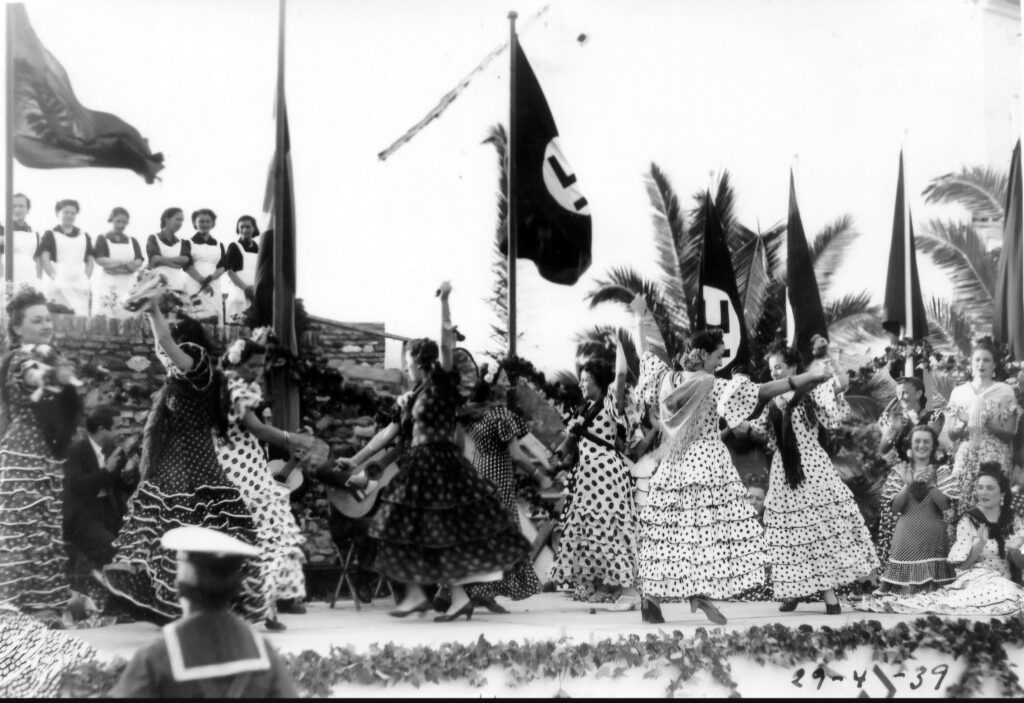
The coordinated project Francoism, Nation and Gender in a Transnational Perspective (FRANGETRANS), funded by the Spanish Ministry of Science, Innovation and Universities and the Spanish Research Agency, is based on the results of a set of projects previously developed at the University of Valencia, linked to the question of nation and nationalism in contemporary Spain. These projects allowed us to confirm the usefulness of the approach of political cultures, as well as the need to continue to deepen transnational and gender perspectives as keys to explaining the right and its projects of nation.
At FRANGETRANS we focus our analyses on the Francoist dictatorship, a central phenomenon in Spain’s contemporary history and an object of study particularly well-suited to the application of the aforementioned perspectives. First, this dictatorship, from the outset, placed the nation at the centre of its long-lasting political project, since the conceptions it developed regarding the nation constituted a core aspect of Francoism, allowing for a comprehensive understanding of it. Second, it relied on the preeminence of the two major political cultures of right-wing, anti-liberal nationalism (reactionary nationalism and fascism), hence the usefulness of applying the political cultures approach. Finally, this dictatorship must be approached from a transnational perspective. Francoism cannot be studied without considering the context of interwar Europe or the post-1945 world, nor without the set of transfers that occurred within it. Not surprisingly, the political cultures that converged in Francoism were markedly transnational.
Furthermore, FRANGETRANS places gender at the forefront, considering it a cross-cutting category that affects the conception and construction of the Francoist nation as a whole. All ideas of nationhood are conceived, developed, and represented in gendered terms, making it essential to delve deeper into this approach for a proper understanding of the national conceptions developed within the Francoist dictatorship.
FRANGETRANS starts from the need to propose the bidirectionality of the transnational dynamics of the Franco dictatorship. In this sense, we analyse in a more complete way the transnational dimension, and understand that the Franco regime was not a mere repository of external influences, but it would interact over time with different movements and contemporary regimes. For this reason, beyond paying attention to its eventual inclusion in predefined models, the dictatorship must be also analysed as a central experience in the construction of general models or perspectives. For this analysis, special attention is paid to the dictatorships and the different political cultures in the Latin American sphere.
Finally, it should also be noted that FRANGETRANS is committed to expanding the necessary interdisciplinary dialogue, highlighting that the exchange of perspectives and analytical and interpretive tools established between historiography and the social sciences allows for a richer and more complex understanding of the centrality of the nation within Franco’s dictatorship.