GÉNERO Y NACIÓN FRANQUISTA
PERSPECTIVAS TRANSNACIONALES E INTERSECCIONALES
(PID2022-141082NB-C22)
GÉNERO Y NACIÓN FRANQUISTA
PERSPECTIVAS TRANSNACIONALES E INTERSECCIONALES
(PID2022-141082NB-C22)
Subproject 2
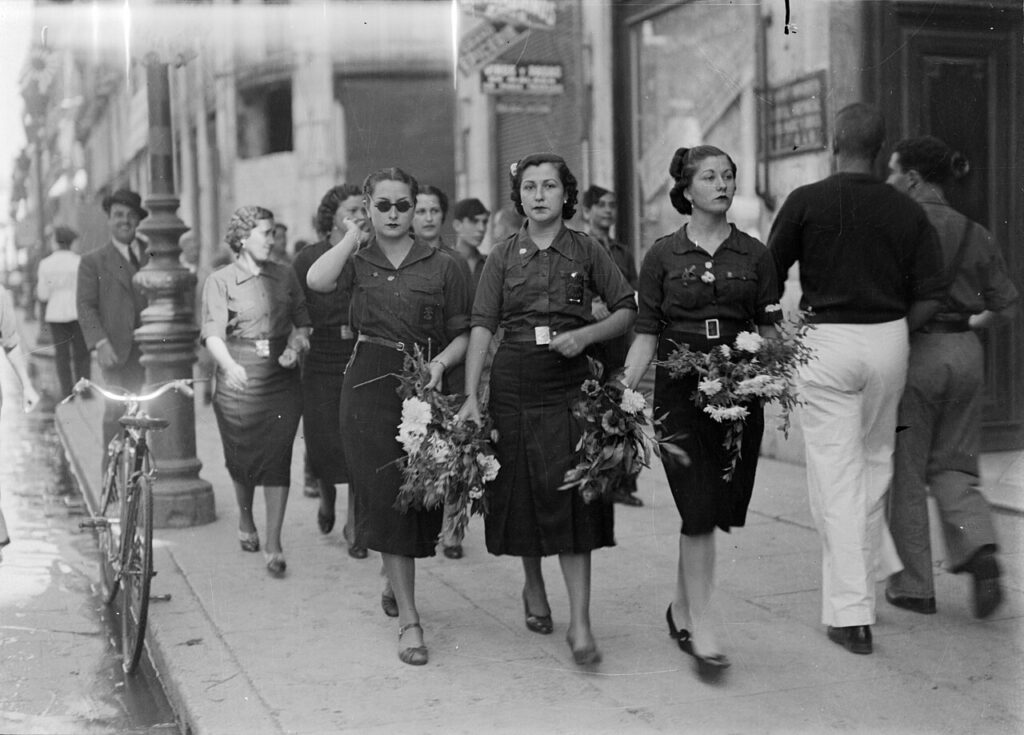
A group of women from the Falange’s Sección Femenina at Larios Street in Málaga (c. 1940).
Source: https://commons.wikimedia.org
Subproject 2, Gender and the Francoist nation. Transnational and intersectional perspectives (PID2022-141082NB-C22), directed by Zira Box and Toni Morant, has as its main objective the study of the Francoist nation from the analytical prism of gender. To that end, in SP2 we started from the work shared with the other subproject, focused specifically on the political and transnational dimension of Francoism based on the centrality that the nation had in it. We share, therefore, a central interest in the nation of the dictatorship, as well as analytical frameworks (specifically, the approach to political cultures) and methodologies. However, we differ in the analytical emphasis when exploring the essential nationalism of the Franco regime with the intention of complementing each other. Thus, if the SP1 has a marked political character, which aims to understand the nationalist dictatorship in the transnational framework of its historical context, in the SP2 we propose to enrich the previous from an innovative interpretation through gender.
Our main hypothesis is that gender was not merely another aspect of Francoist nationalism, related primarily to shaping the identities of national subjects, but rather a central category of analysis that transversally affected the construction of the Francoist nation as a whole. Consequently, we examine how the ideas of nation were permeated by connotations of masculinity, virility, and femininity, questioning the effects it had and how this gendering manifested itself. Our aim is to propose an interpretation of the Francoist nation —of the discourses, representations, practices, identities, and nationalist policies developed by the dictatorship— based on the hypothesis of its implicit gendered nature.
To achieve its objective, SP2 adopts a distinctly interdisciplinary approach to the notion of gender, aiming to understand it as a key category that ultimately relates to how worldviews and the constructions of meaning through which power is articulated are produced. Its intersection with the idea of nation is based on the conviction that both are interrelated and that, if the national principle functioned as an essential core in the organization of Francoism, studying it through gender, understood in this way, can shed new light on what we understand as the Francoist nation.
Finally, SP2 emphasizes considering gender as an analytical category that must be understood intersectionally, exploring how cultural meanings about sexual difference are intertwined with other equally transversal categories, especially with social class (important and usually invisible in the understanding of some fundamental ideas of Francoist nationalism), as well as with race, given that we analyze the Francoist nation from a transnational perspective taking into account the multiple connections (also symbolic) with its context.
Our main hypothesis is that gender was not merely another aspect of Francoist nationalism, related primarily to shaping the identities of national subjects, but rather a central category of analysis that transversally affected the construction of the Francoist nation as a whole. Consequently, we examine how the ideas of nation were permeated by connotations of masculinity, virility, and femininity, questioning the effects it had and how this gendering manifested itself. Our aim is to propose an interpretation of the Francoist nation —of the discourses, representations, practices, identities, and nationalist policies developed by the dictatorship— based on the hypothesis of its implicit gendered nature.
To achieve its objective, SP2 adopts a distinctly interdisciplinary approach to the notion of gender, aiming to understand it as a key category that ultimately relates to how worldviews and the constructions of meaning through which power is articulated are produced. Its intersection with the idea of nation is based on the conviction that both are interrelated and that, if the national principle functioned as an essential core in the organization of Francoism, studying it through gender, understood in this way, can shed new light on what we understand as the Francoist nation.
Finally, SP2 emphasizes considering gender as an analytical category that must be understood intersectionally, exploring how cultural meanings about sexual difference are intertwined with other equally transversal categories, especially with social class (important and usually invisible in the understanding of some fundamental ideas of Francoist nationalism), as well as with race, given that we analyze the Francoist nation from a transnational perspective taking into account the multiple connections (also symbolic) with its context.