FRANQUISMO Y NACIÓN
PERSPECTIVAS TRANSNACIONALES
(PID2022-141082NB-C21)
FRANQUISMO Y NACIÓN
PERSPECTIVAS TRANSNACIONALES
(PID2022-141082NB-C21)
Subproject 1
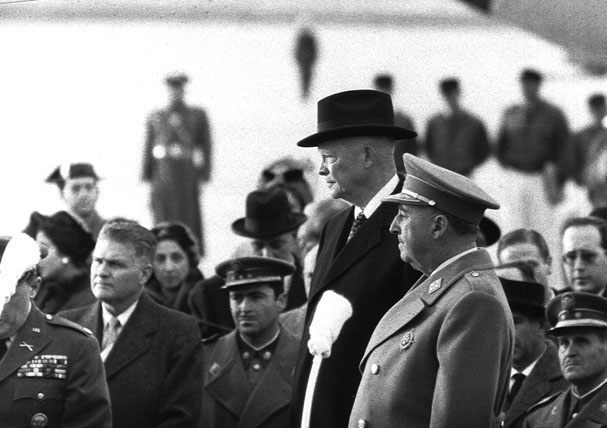
Franco and US President Eisenhower in Madrid, during the latter’s visit to Spain in 1959.
Source: https://commons.wikimedia.org
Subproject 1, “Francoism and Nation: Transnational Perspectives” (PID2022-141082NB-C21), led by Ismael Saz and Julián Sanz, focuses specifically on the Franco Dictatorship within a broad context, both temporally (from its antecedents to its legacies) and spatially (considering its integration into international dynamics). As an object of study, the Franco dictatorship is, for different reasons, of special relevance and utility for applying the approaches of political cultures and transnational history: its character as a nationalist dictatorship, the presence within it of different transnational political cultures (notably, fascist and reactionary nationalist), as well as the need and interest of using the transnational perspective in its analysis.
Therefore, we research the Francoist dictatorship within the context of right-wing, anti-liberal dictatorships and political cultures, exploring how it was perceived by and, in turn, interacted with them. We thus argue for the need to give Francoism a central place in the construction of explanatory models of this type of dictatorships. Our analyses prioritize the evolution of conceptions of nation and gender within the political cultures present during the Francoist dictatorship. In this regard, we delve into the study of how transnational dynamics influenced the development of intrinsically gendered national conceptions and policies, paying attention to the circulation of ideas, people, exchanges, influences, and networks within the international framework, especially in the European and Ibero-American spheres.
Furthermore, addressing the national question involves analysing the discourses, conceptions, representations, and imaginaries of the nation, national history, and the region, as well as the articulation between nation-building projects, territorial policies, and the centre-periphery dialectic. It is also necessary to study the formation of the economic and social projects present during the Francoist dictatorship, which were directly related to the regime’s national project. All of this is carried out through a transnational and comparative perspective that considers the full range of influences, networks, and ideas that intersected and were exchanged in international spheres throughout the period under analysis.